Workflows that reshape, reroute, and orchestrate.
Transform sets rewrite outbound requests per channel. Model-mapping rules reroute model names with glob matching. Fallback channels carry failures across priority tiers. Chain them for end-to-end request control — no code changes.
The per-channel pipeline
A request flows through a transform set, then a model-mapping rule set, before reaching upstream. Authentic-origin channels bypass transforms — official direct connections need no rewriting.
Request
POST /v1/chat
Transform Set
strip · rename · set
Model Mapping
gpt-4* → glm-5
Upstream
provider ✓
Request transform sets
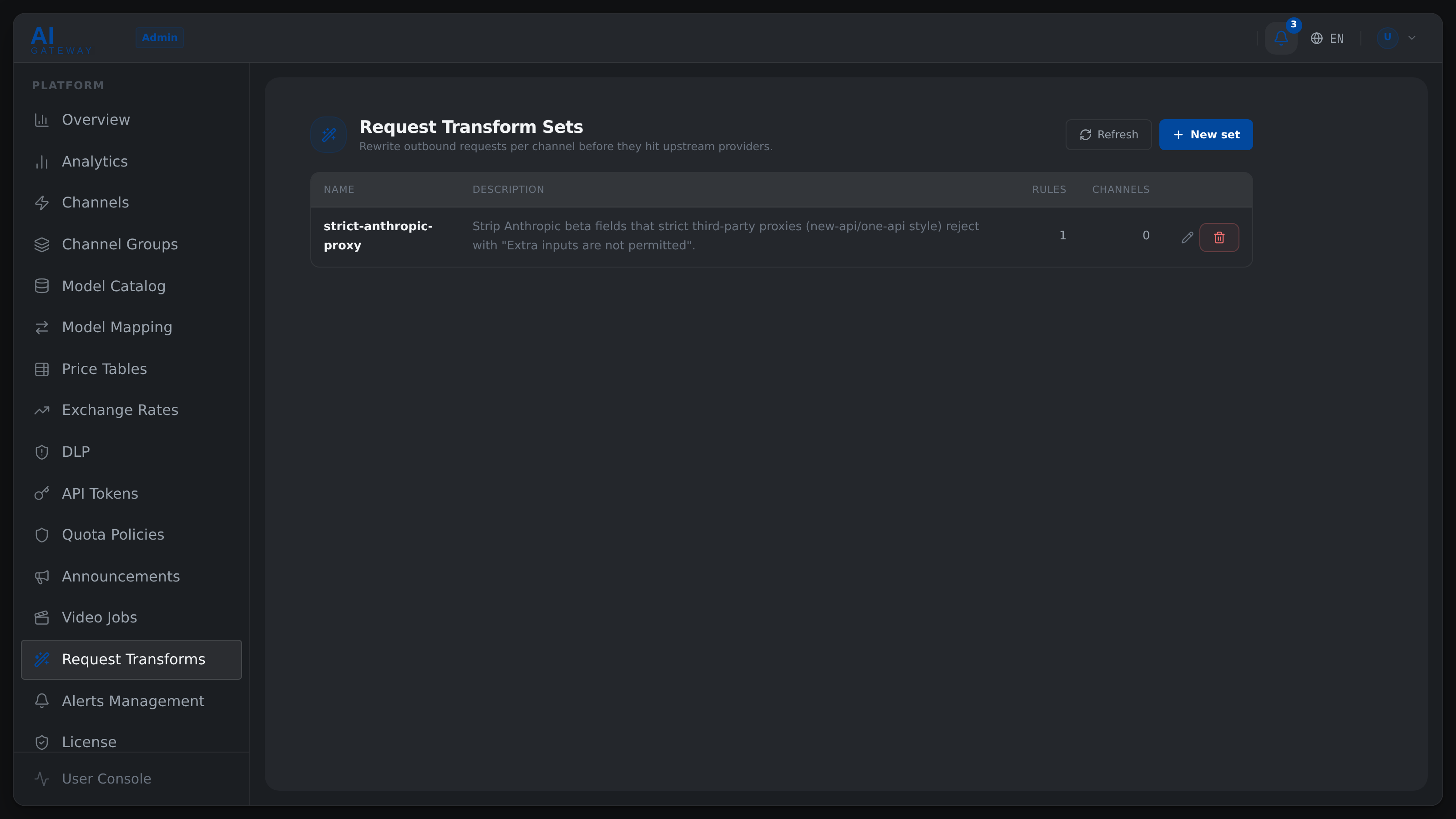
Rewrite outbound payloads per channel before they hit upstream: strip_header, rename_header, set_header, strip_body_field, set_body_field. Match with glob wildcards; body paths are dot-separated like messages.*.thinking.
Model mapping rules
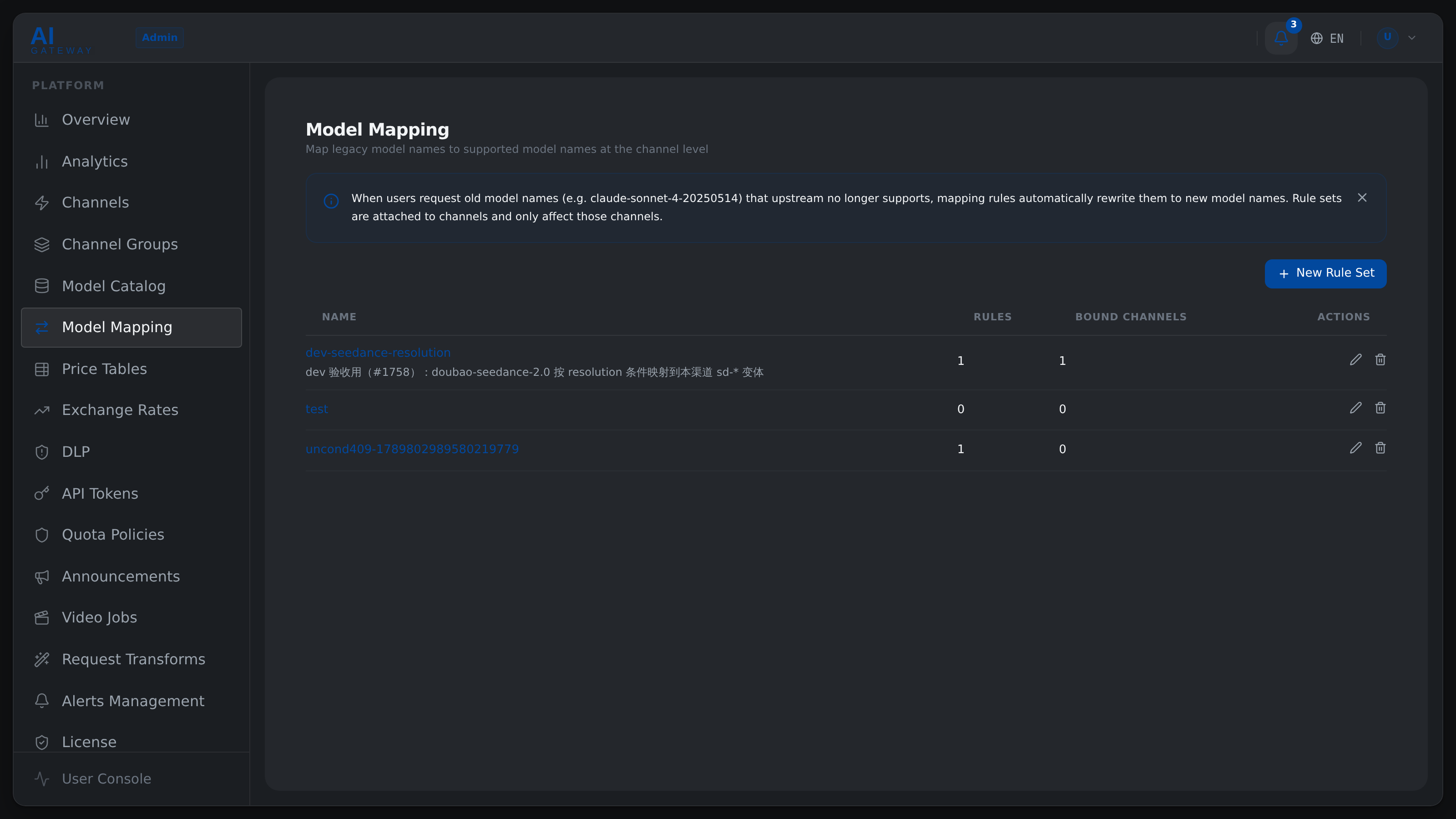
Reroute model names per channel: send gpt-4* to glm-5, claude-* to deepseek-v4. Rule sets evaluate in order with a built-in routing test, so you can verify the rewrite before going live.
First-class fallback channels
Fallback channels are now schema-level citizens with admin API and console support. A forced tail segment runs at the end of the chain, and fallback degrades strictly across priority tiers — a failure skips the same-priority pool.
Channel clone with attachments
Cloning a channel copies its attachments too — model mappings, price-table assignments, and fallback rules travel with the clone. No more reconfiguring a duplicated channel by hand.
Transform sets
Configure header and body rewrites per channel. Rules apply in order; authentic-origin channels bypass them entirely.
Model mapping
Rule sets with glob wildcards and an evaluation order. Run the routing test to confirm a model name lands where you expect.
Wire up your request pipeline
Transforms, mapping, and fallback — all configured in the console, applied without touching client code.
Get started